

The short answer is 2020 through 2023. Here is the long answer, generation by generation, with the specific things worth checking on each one before you hand over any money.
The best year for a used Toyota 4Runner is 2020 to 2023. Those are late fifth-generation trucks, and 2020 is the year two things landed at once: Toyota Safety Sense P became standard equipment across the lineup, and the dashboard finally got an 8-inch touchscreen with Apple CarPlay and Android Auto. Everything underneath was already proven by then.
Buying older, a 2010 to 2019 4Runner is mechanically the same truck for meaningfully less money. Buying newer, the 2025 and up sixth generation swaps the old V6 for a turbocharged four and a hybrid, and it is the biggest change the 4Runner has seen in fifteen years.
The 4Runner is a body-on-frame SUV with a truck chassis under it, so it does not behave like a crossover and it does not get crossover fuel economy either. Ratings below are EPA combined figures rounded to the nearest mile per gallon. Look up the exact rating for a specific year and drivetrain at fueleconomy.gov.
| Model Years | Generation | Engine | Fuel Economy | What You Get | Verdict |
|---|---|---|---|---|---|
| 2025 to now | Sixth | 2.4L turbo four or hybrid | Best of any 4Runner, check the exact figure by trim | New platform, 8-speed automatic, much bigger screens, hybrid option with a big torque number | Newest |
| 2020 to 2023 | Fifth, late | 4.0L V6 | About 17 mpg | Toyota Safety Sense P standard, 8-inch screen with Apple CarPlay and Android Auto standard | Best Buy |
| 2024 | Fifth, final | 4.0L V6 | About 17 mpg | The last year of the old truck, mostly special editions, priced accordingly | Best Buy |
| 2015 to 2019 | Fifth, mid | 4.0L V6 | About 17 mpg | Post-refresh styling, TRD Off-Road and TRD Pro trims established, no CarPlay | Strong |
| 2010 to 2014 | Fifth, early | 4.0L V6 | About 17 mpg | Same engine and transmission as a 2023, older cabin and older infotainment | Best Value |
| 2003 to 2009 | Fourth | 4.0L V6 or 4.7L V8 | About 15 to 18 mpg | The old-school one, V8 available, simple to service, plentiful and inexpensive | Budget Pick |
Most used-car advice tells you to buy the newest example you can afford. The 4Runner is the vehicle where that advice bends, because it holds its value better than almost anything else with four doors. Toyota built essentially the same truck from 2010 to 2024, demand never softened, and the used market prices these accordingly.
Two things follow from that. First, a used 4Runner is rarely cheap, and a suspiciously cheap one deserves a longer look at the history report. Second, the money you spend is not really gone. A 4Runner you buy today and sell in four years is likely to give a larger share of it back than a comparable crossover would.
That is also why buying two or three years older costs less than you would expect it to save. A 2016 and a 2021 are the same truck mechanically, but the 2021 has the safety suite and the phone mirroring, and the price gap between them is narrower than the year gap suggests. If you are trading something in, run an instant trade quote on your current vehicle before you shop, so you are comparing real out-of-pocket numbers rather than sticker prices.
Browsing more broadly is worth it too. Our used SUV inventory covers everything from two-row crossovers to three-row haulers, and a 4Runner is a specific answer to a specific question rather than the default one.
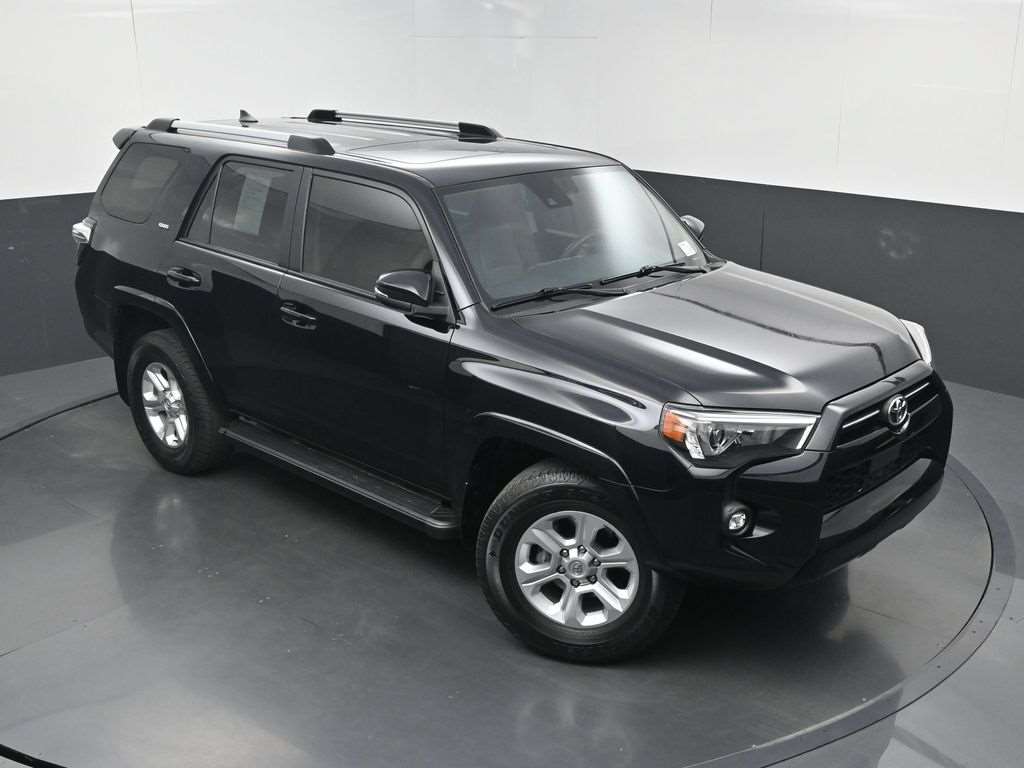
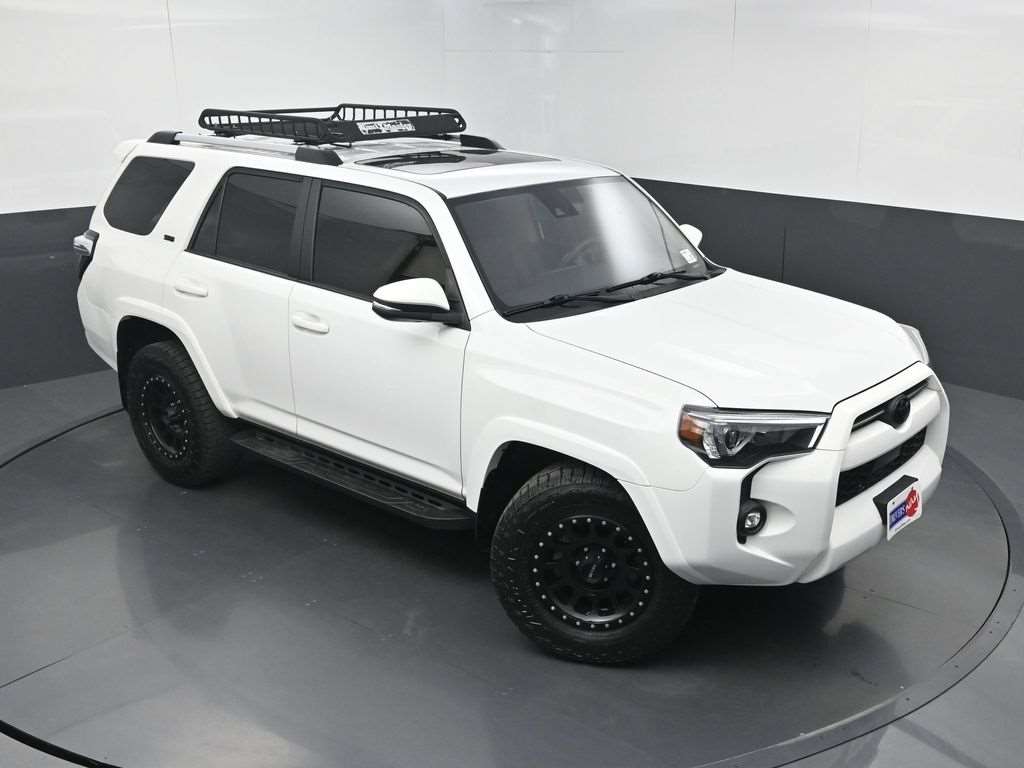
A 2023 4Runner, a late fifth-generation truck of the kind this page recommends. The body-on-frame shape barely changed between 2010 and 2024, which is a large part of why values hold.
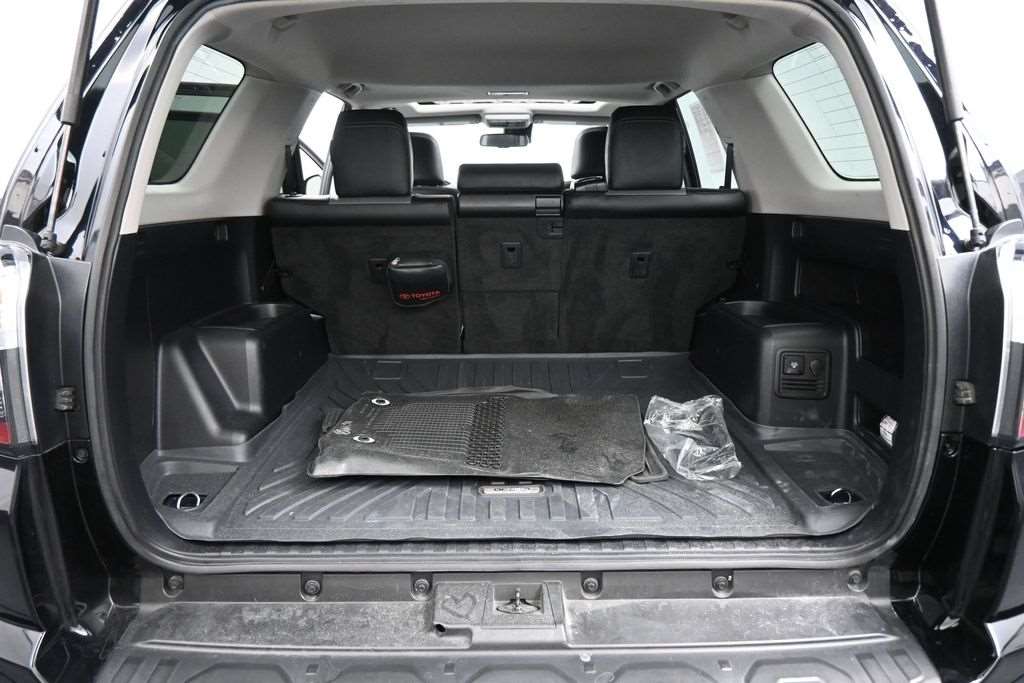
Cargo space behind the second row of a 2023 4Runner. Squared-off, flat-floored practicality is a good part of why demand for these never softened.
Buy this one if you want the modern cabin and the towing headroom, and your budget reaches a nearly new truck.
Toyota moved the 4Runner onto the same architecture as the current Tacoma and replaced the 4.0-liter V6 with a turbocharged 2.4-liter four called i-FORCE, backed by an 8-speed automatic. A hybrid version, i-FORCE MAX, sits above it and produces a genuinely large torque figure, which is what you feel pulling a boat trailer up out of a launch or merging onto I-459.
The cabin is the other half of the story. Screens are much larger, the switchgear is current Toyota rather than a decade-old design, and the driver-assist package is the newest version rather than the 2020 one. Towing capacity goes up as well, which matters if you have been at the limit of the old truck.
Two honest caveats. These are recent enough that used examples are close to new-vehicle money, and they have not accumulated the fifteen-year service record the old truck has. That record is exactly why people trust the 4Runner, so if long-term proof is the reason you want one, the fifth generation is still the safer answer.
A 2020 to 2023 4Runner is the best mix of price, safety equipment and known-good engineering you can buy.
This is the generation that built the reputation. Toyota fitted a 4.0-liter V6, the 1GR-FE, to a five-speed automatic in 2010 and then left the powertrain essentially alone for fourteen model years. There was no new engine to debug, no new transmission to learn, and no generation-one teething. A 2010 and a 2023 share the same mechanical package, which is why independent shops know these trucks cold and why parts are everywhere.
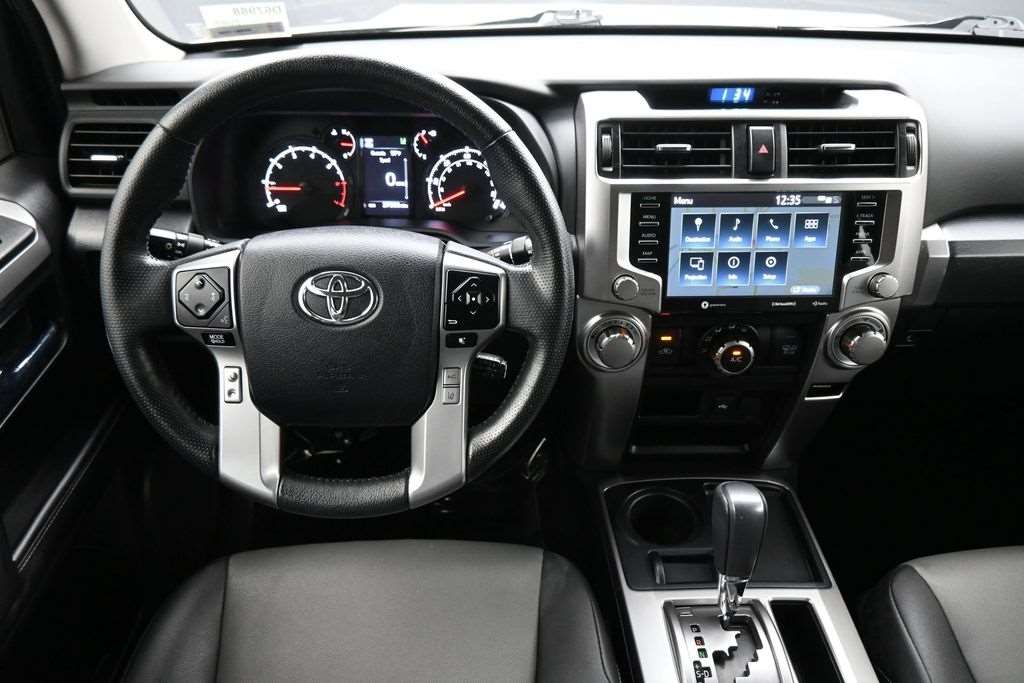
The reason to target 2020 and later is equipment, not durability. For 2020 Toyota made Toyota Safety Sense P standard across the lineup, which bundles pre-collision braking, lane departure alert and radar cruise control. The same year the dash got an 8-inch touchscreen with Apple CarPlay and Android Auto standard. Before that you were living with a small, dated screen and no phone mirroring, which on a truck you plan to keep ten years is a real daily annoyance.
Now the honest part. The 4.0-liter V6 is an old design and it drinks accordingly, landing around 17 mpg combined per fueleconomy.gov regardless of which year you pick. The five-speed automatic has fewer gears than anything else on the road in 2026. The ride is truck-like because it is a truck. That is the trade. You give up fuel economy and refinement, and in exchange you get a vehicle that goes 250,000 miles without drama and sells for real money when you are done with it.
Trims are worth understanding before you shop. SR5 and SR5 Premium are the volume trims and are the only ones besides Limited that can be had with the optional third row. TRD Off-Road and TRD Off-Road Premium add a locking rear differential and a terrain-management system, which matter on Oak Mountain trails and matter very little on Hwy 280. Limited trades the off-road hardware for leather, a full-time four-wheel-drive system and a smoother ride. TRD Pro is the low-volume halo trim and is priced like one on the used market.
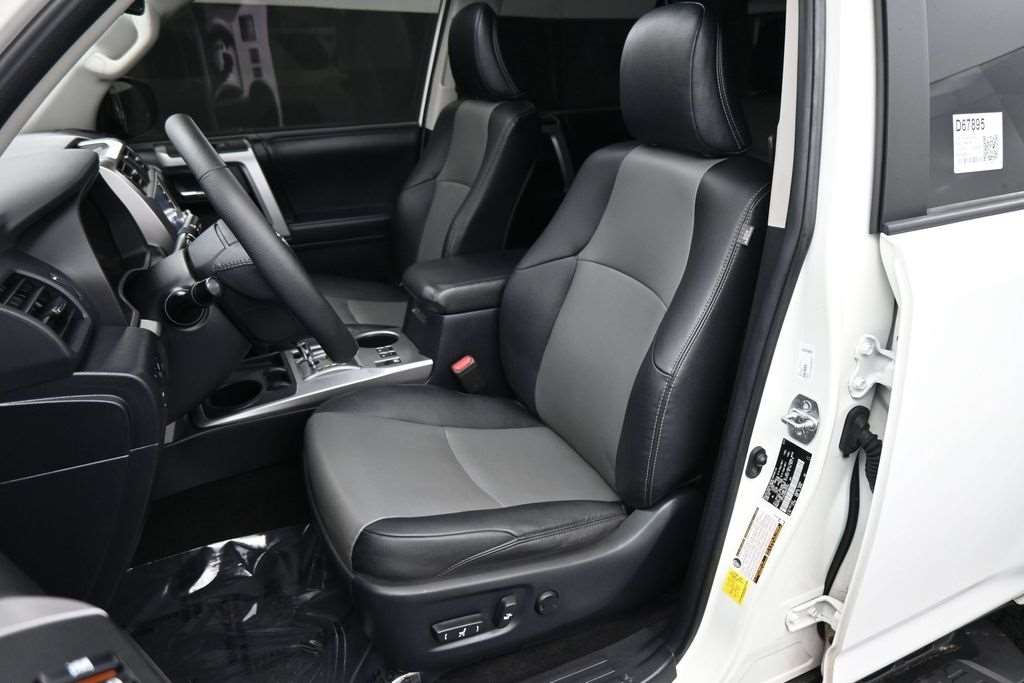
The one to shop if you want the most working truck per dollar and you are comfortable buying on history rather than on mileage.
The fourth generation introduced the 4.0-liter V6 that would go on to serve for two more decades, and it is also the last 4Runner you could order with a V8. The 4.7-liter is smooth, torquey and thirsty, and it has a following for good reason. The V6 is the more sensible choice and the easier one to find. The V6 moved to a five-speed automatic partway through the generation, which is worth confirming on any specific truck.
At this age the paperwork matters far more than the odometer. A well-kept 2007 with a folder of records is a better purchase than a low-mileage 2009 with no history at all. We wrote a longer piece on exactly that question in how many miles is too many on a used car, and the 4Runner is the vehicle that makes the argument best.
One genuine advantage of shopping these in Alabama: the undercarriage rust that shortens the life of a fourth-generation 4Runner in the salt-belt states is a northern problem, not a Shelby County one. A truck that has spent its life between Birmingham and the coast is a fundamentally different proposition from one that came down from Ohio. Still get underneath it and look.
Every Driver's Way price is the price. There is no negotiation, no three trips to a manager's office, and nobody on our sales floor works on commission, so nothing below is steering you up a tier. If a hard ceiling is the real constraint, start with our vehicles under $20,000 and work backward from there.
The same 4.0-liter V6 and five-speed automatic as a 2023, in an older cabin without CarPlay. Ask for the fluid service records and you have a truck with another decade in it.
Toyota Safety Sense P standard, the 8-inch screen with Apple CarPlay and Android Auto, and fourteen years of proven mechanicals behind it. This is the recommendation for most buyers.
A locking rear differential and terrain management, which earn their keep at Oak Mountain State Park and on a wet boat ramp. Skip it if your weekends stay on pavement.
Everything above is what you would check yourself buying from a stranger on Facebook Marketplace. Buying from us, it is already done and written down. If you want the full walkthrough, we published what to look for when buying a used car, and you can see how the 4Runner stacks up against its own showroom sibling in our guide to the best year for a used Toyota RAV4.
Every vehicle we list is inspected and reconditioned before it goes on the lot.
Nearly three decades of used cars in the Birmingham metro, at two locations.
Nobody here earns more by putting you in a bigger truck than you came for.
Every listing comes with the vehicle history report, no asking required.
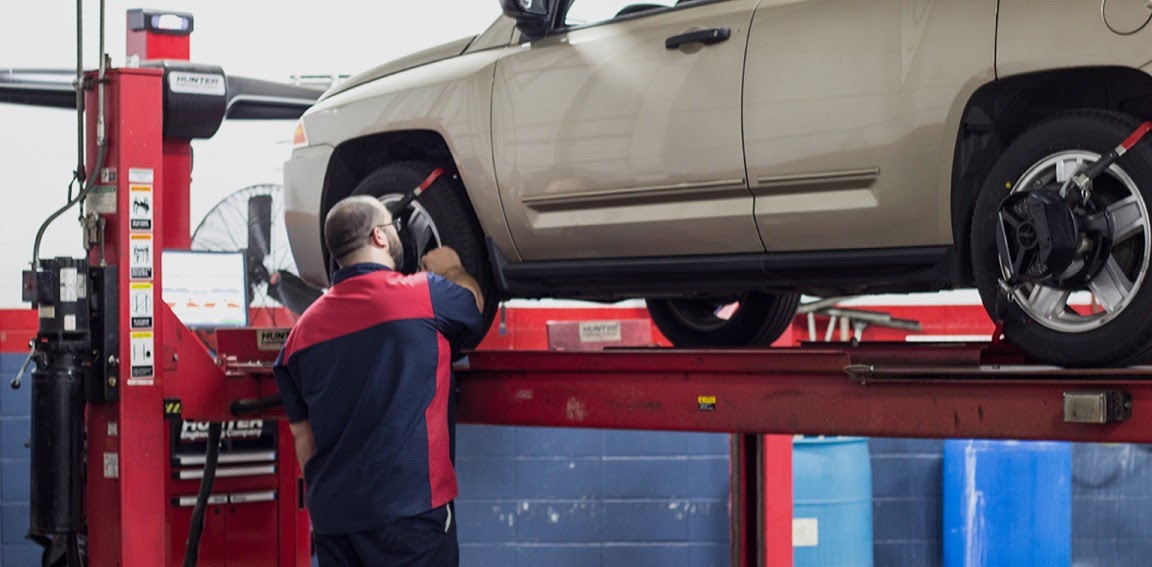
Reconditioning and service for both stores happen at our Pelham service department, which is open Saturdays.
Reviews from our Hwy 280 store, pulled live from Google.
We are at 5470 Hwy 280, a few minutes from Inverness and about fifteen from Mountain Brook. Vestavia Hills, Hoover and Trussville are all an easy run. If the SUV you want is sitting at our Pelham store, tell us and we will bring it over.
Inventory moves fast and a good 4Runner never sits long. Check what is here right now, or tell us what you are after and we will call you when one lands.
Driver's Way Hwy 280 | 5470 Hwy 280, Birmingham, AL 35242